
TL;DR:
- Proprioceptive input is the body’s internal sense from muscles, joints, and tendons that guides movement and regulation. It plays a crucial role in children’s body awareness, balance, emotional stability, and daily skills, especially for neurodiverse kids. Supporting it through purposeful activities like carrying, climbing, and pushing can enhance their overall development and regulation.
If you’ve ever watched your child crash into the sofa cushions for the tenth time, ask for another bear hug, or stomp across every puddle they can find, you’ve seen proprioceptive input in action — you just didn’t have the word for it yet. Understanding what is proprioceptive input can genuinely change how you see your child’s behaviour, shifting frustration into curiosity and, eventually, into real, practical support. This guide explains exactly what proprioception is, why some children need more of it than others, and what you can do about it starting today.
Table of Contents
- What proprioceptive input means and why it matters
- How proprioceptive input supports children’s everyday skills and regulation
- Why proprioceptive needs differ in children and what that means for parents
- Practical ways to support proprioceptive input for your child
- A parent’s perspective on proprioceptive input: what most people miss
- Finding sensory support and proprioceptive play in Brighton
- Frequently asked questions
Key Takeaways
| Point | Details |
|---|---|
| Proprioception explained | Proprioceptive input is sensory feedback from muscles and joints that informs the brain about body position and movement without needing to look. |
| Supports regulation | This input helps children stay calm, focused and coordinate movements smoothly in daily life. |
| Individual sensory profiles | Children differ: some need more proprioceptive input while others find it overwhelming, so support must be personalised. |
| Active muscle use matters | Activities involving pushing, pulling and carrying give the strongest proprioceptive signals that aid self-regulation. |
| Professional guidance helps | Sensory strategies work best when tailored and supervised to avoid ineffective or counterproductive approaches. |
What proprioceptive input means and why it matters
Proprioceptive input is your body’s hidden sixth sense. It has nothing to do with sight, sound, or touch in the traditional sense. Instead, it’s the continuous stream of information flowing from your muscles, joints, and tendons to your brain, telling it where each body part is, how much force is being used, and how everything is moving. Think of it as your brain’s internal sat-nav for the body.
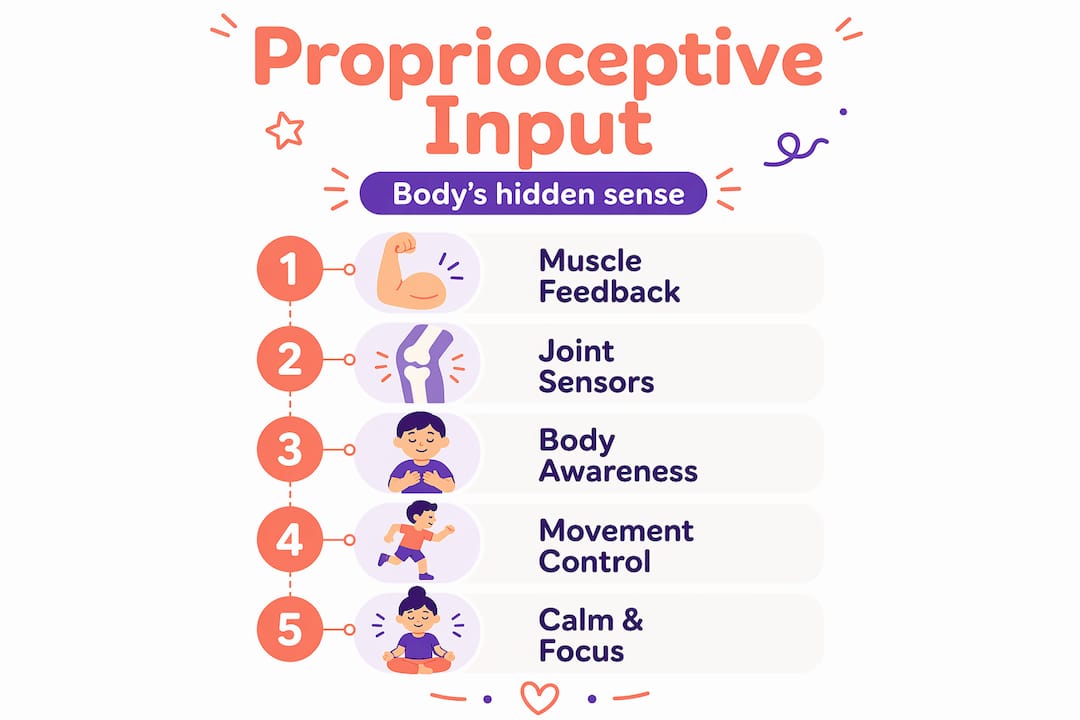
As proprioceptors explained by Kenhub, proprioceptive input is the internal sensory information that tells the brain about the body’s position, movement, and force without relying on vision, mediated by receptors in muscles, tendons, and joints.
This matters enormously for children. A young child’s nervous system is still learning to process and integrate all of this incoming information. For many neurodiverse children, that processing doesn’t happen automatically or efficiently.
Here’s what proprioceptive input supports in daily life:
- Body awareness: Knowing where your limbs are without looking, which matters for dressing, eating, and climbing.
- Force regulation: Understanding how hard to grip a pencil, hug a friend, or place a cup down without breaking it.
- Balance and coordination: Staying upright, navigating stairs, and moving smoothly without constant stumbling.
- Emotional regulation: When the brain gets consistent proprioceptive updates, children feel more settled and grounded.
- Arousal levels: Proprioceptive input is one of the most powerful ways to shift a child from dysregulated to calm.
“When my son spent a whole morning trying to knock things over, I used to think he was being defiant. Once I understood proprioception, I realised his brain was essentially shouting: ‘I need more information about where my body is right now.’ That reframe changed everything.”
Understanding sensory play approaches that target proprioception specifically can help parents move from reactive to proactive, which is a genuinely powerful place to be.
How proprioceptive input supports children’s everyday skills and regulation
The importance of proprioceptive input goes well beyond movement. It threads through almost every functional skill a young child needs to develop. Let’s look at exactly how.
-
Self-regulation. When proprioceptive input reaches the brain consistently, it acts like an anchor. Children feel more organised internally, which means less meltdowns, less anxiety, and a longer window of calm. Proprioception and self-regulation are closely linked, with evidence showing it helps children stay calm, focused, and ready to learn.
-
Coordinated movement. Walking without tripping, catching a ball, or climbing a frame all require the brain to predict and adjust body position constantly. Proprioceptive feedback makes those micro-adjustments possible in real time.
-
Postural control. Children who struggle to sit without slumping or stand without leaning against walls are often working harder than you realise. Their muscles aren’t receiving clear proprioceptive signals, so maintaining an upright position is genuinely effortful, not lazy.
-
Spatial awareness. Understanding where your body ends and the world begins is a proprioceptive skill. Children who bump into furniture, misjudge distances, or accidentally hurt other children during play may have proprioceptive processing differences.
-
Speech and eating. This one surprises many parents. The mouth and jaw are full of proprioceptors too. As the evidence on proprioceptive input for kids shows, proprioceptive feedback also supports effective speech production by helping the muscles of the mouth and jaw coordinate properly.
Pro Tip: If your child mouths objects, chews their clothing, or loves chewy snacks, their mouth may be seeking proprioceptive input. Chewy snacks like carrot sticks, or a chewable sensory tool, can be a safe and effective way to meet that need.
When you attend our sensory play sessions, you’ll see activities designed with all of these areas in mind. There’s intention behind every heavy cushion and every tug-of-war rope. For families looking for a sensory playgroup in Brighton that gets it, we’ve built our sessions around exactly this kind of purposeful play.
Why proprioceptive needs differ in children and what that means for parents
Here’s something that tripped me up for a long time: proprioceptive input isn’t a one-size-fits-all solution. The same activity that settles one child completely can tip another child right over the edge into overwhelm.
Every child has what occupational therapists call a sensory profile: a pattern of how their nervous system responds to different types of input. When it comes to proprioception specifically, children broadly fall into two patterns:
- Under-responsive (sensory seeking): These children need more input to feel regulated. They crave crashing, jumping, being squeezed, carrying heavy things, and rough-and-tumble play. Their threshold is high, so ordinary movement just doesn’t register enough to feel organising.
- Over-responsive (sensory avoiding): These children find strong proprioceptive input overwhelming. What looks like “fun” heavy play to you might feel genuinely distressing to them, triggering anxiety or a shutdown response.
As research on sensory profiles shows, the same heavy work activity might help one child and hinder another entirely depending on their individual sensory profile.
“Some children are under-responsive and seek more input, while others are over-responsive and find certain movement or touch overwhelming. The same ‘heavy work’ might help or hinder depending on the child’s sensory profile.”
What does this mean for you practically? Watch your child during and after proprioceptive activities. Do they become calmer, more focused, and easier to connect with? Or do they escalate, become more agitated, or withdraw? Their response is the data you need.
Pro Tip: Keep a simple notebook for one week. After any movement-heavy activity, jot down whether your child seemed more regulated or less regulated for the hour that followed. Patterns will emerge faster than you expect, and they’ll give you something really useful to share with an occupational therapist.
If you’re exploring customising sensory input for your child, this kind of observation is the starting point for getting it right.
Practical ways to support proprioceptive input for your child
The best proprioceptive activities for kids are the ones that involve real muscle effort and joint compression. Light touch or passive movement just doesn’t activate the proprioceptors in the same way. Here’s what actually works:
- Pushing and pulling heavy objects. Pushing a loaded buggy, pulling a sibling in a wagon, or pushing a trolley at the supermarket all count as excellent proprioceptive input in everyday life.
- Carrying weighted items. A small backpack with books, carrying a bag of shopping for a short distance, or moving a pile of thick books from one room to another gives muscles and joints the feedback they need.
- Climbing. Climbing frames, low walls, soft play structures, and even climbing the stairs while carrying something provide consistent proprioceptive feedback.
- Crashing and tumbling safely. Jumping onto crash mats, rolling on a thick rug, or landing in a pile of cushions are all purposeful proprioceptive activities when framed as play.
- Wall push-ups and chair press-downs. For calmer moments, pressing both palms flat against a wall and pushing for 10 seconds, or pressing down on the seat of a chair while sitting, activates joint and muscle receptors quickly. These are ideal transition activities before moving between settings.
As heavy work research confirms, activities that clearly involve muscle and joint effort like pushing, pulling, lifting, carrying, and climbing provide stronger, more consistent feedback to help organise behaviour around transitions.
| Activity | Proprioceptive benefit | Best timing |
|---|---|---|
| Carrying a heavy bag | Joint compression and muscle effort | Before school or nursery |
| Climbing a frame | Full body proprioceptive feedback | During outdoor play |
| Wall push-ups | Quick joint activation | Before transitions |
| Chewy foods or tools | Jaw and mouth proprioception | Mealtimes or when unsettled |
| Pushing a heavy trolley | Sustained muscle and joint input | Shopping trips |
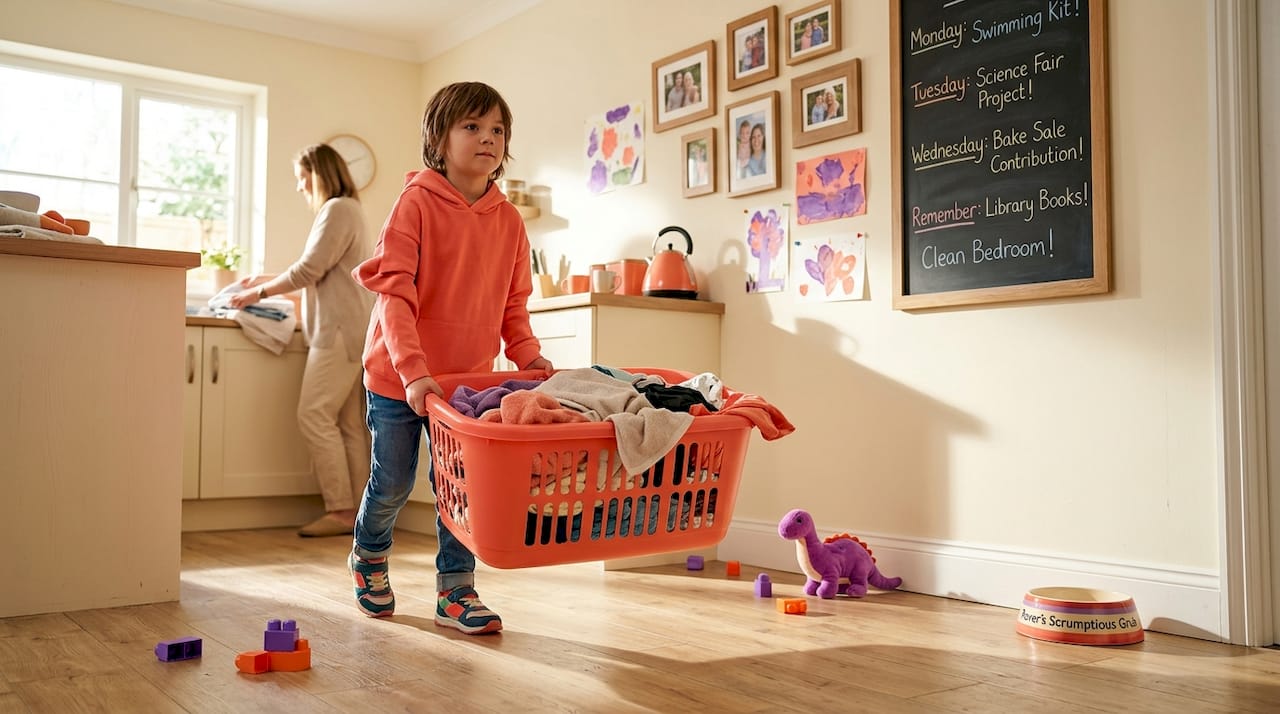
Pro Tip: Build proprioceptive activities into existing routines rather than adding extra sessions. Making your child “the helper” who carries the shopping, pushes the buggy, or moves the laundry basket gives them the input they need without it feeling like therapy.
Our proprioceptive play activities at Fidget and Spin are designed to weave this kind of purposeful input naturally into every session, so children benefit without it ever feeling clinical.
A parent’s perspective on proprioceptive input: what most people miss
Here is the thing nobody tells you at the beginning: proprioceptive input is not just about movement or pressure. It’s a continuous feedback loop. The brain isn’t passively receiving signals; it’s constantly updating its model of the body based on what the muscles and joints are doing. When that loop is disrupted or noisy, a child doesn’t just feel physically unsteady. They feel emotionally unsteady. That’s the connection most people miss entirely.
I also see a lot of well-meaning parents conflate proprioception with deep pressure. They’re related, but they’re not the same sensory channel. A weighted blanket provides comforting deep pressure through the skin, which is a tactile experience. Carrying a heavy bag activates the muscles and joints — that’s proprioception. Both can be calming, but they work through different pathways. Using one when you mean the other can leave you wondering why a strategy isn’t working.
Working with a paediatric occupational therapist changed our family’s approach completely. They helped us see that our child’s responses were evolving, what worked brilliantly at age two needed adjusting by age four. The sensory support insights we gathered through professional guidance kept us from spending months on approaches that simply didn’t fit anymore.
There’s also something worth saying about community. Speaking with other parents in similar situations, the kind of honest, unfiltered conversations you get in a group of people who genuinely understand, helped me identify patterns in my child’s behaviour I’d been too close to see. Some families even find that paediatric chiropractic care offers another avenue to explore proprioceptive processing, though always in consultation with your child’s existing health team.
Stay patient, stay curious, and stay adaptable. Your child’s sensory needs are not a fixed problem to be solved. They’re a shifting landscape to be understood.
Finding sensory support and proprioceptive play in Brighton
If any of this has felt like a lightbulb moment, you’re not alone. Understanding what your child’s body needs is the first step. Knowing where to go next is the second.
At Fidget and Spin, our sensory play sessions are built around exactly the kinds of activities described in this guide: climbing, pushing, carrying, crashing, and moving with purpose in a safe, joyful environment designed for neurodiverse children aged 1 to 7 in Brighton and Hove. Every session is structured with themed sensory zones that naturally offer proprioceptive input alongside other sensory experiences. You’ll also be surrounded by other families who get it, no explaining needed. Find out how sensory sessions support proprioception or take the first step and join our waitlist today.
Frequently asked questions
What exactly is proprioceptive input?
Proprioceptive input is sensory feedback from muscles, joints, and tendons that continuously tells the brain where the body’s parts are, how they’re moving, and how much force is being used, all without needing to look.
How does proprioceptive input help my child stay calm?
It gives the brain continuous updates about body position and movement, which helps children feel more organised and grounded internally, directly supporting emotional regulation and the ability to focus.
Are proprioception and deep pressure the same thing?
No. Proprioception comes from muscle and joint sensors responding to position and force, while deep pressure is a tactile experience processed through the skin. Mixing up these two distinct channels can affect how well your strategies actually work.
How do I know if my child needs more or less proprioceptive input?
Watch whether your child seeks movement and pressure to stay calm (under-responsive) or becomes distressed by it (over-responsive), then tailor your approach based on what their body is actually telling you.
Can I do proprioceptive activities at home safely?
Yes. Simple everyday activities like climbing, carrying bags, or pushing heavy objects to regulate the nervous system work well at home; watch your child’s response carefully and consult an occupational therapist if you’d like a more tailored plan.