
TL;DR:
- Social referencing involves infants seeking emotional cues from caregivers to decide how to respond to new situations. Neurodiverse children may process these cues differently, requiring clearer signals and support for understanding emotions. Recognizing and supporting social referencing through consistent, explicit expressions builds trust and emotional confidence over time.
Every parent has watched a baby freeze at something new, then shoot a look straight at them as if to say, “Is this okay? Should I be scared?” That tiny glance is social referencing in action, and it matters far more than most of us realise. Understanding what is social referencing gives parents and educators a completely new lens for reading a child’s behaviour, especially when that child is neurodiverse. This article walks through what it is, how it develops, and what you can actually do with that knowledge day to day.
Table of Contents
- Key takeaways
- What is social referencing?
- How social referencing develops in neurodiverse children
- Everyday examples of social referencing
- Supporting social referencing in neurodiverse children
- Social referencing versus related concepts
- My honest experience as a parent
- Sensory play that supports social referencing
- FAQ
Key takeaways
| Point | Details |
|---|---|
| Social referencing starts early | Children typically begin looking to caregivers for emotional cues between 8 and 12 months of age. |
| Caregivers are emotional teachers | Your facial expressions and tone directly shape how a child decides whether a new situation is safe or scary. |
| Neurodiverse children may differ | Some children with autism or ADHD process social cues differently, requiring extra support and patience. |
| Negative cues carry more weight | Children respond more strongly to fearful or negative expressions, so calm and positive signals matter enormously. |
| Sensory play helps build the skill | Safe, structured environments give neurodiverse children repeated, low-pressure chances to practise reading social cues. |
What is social referencing?
Parents often assume very young babies are just reacting to the physical world around them. But even before a child can speak, they are doing something quite sophisticated: checking in with you to decide how to feel. That is the definition of social referencing, and it changes how you see almost every hesitant moment in early childhood.
Social referencing is the process by which infants look to a trusted caregiver’s facial expressions, tone of voice, or gestures when they encounter something new or uncertain, and then adjust their own behaviour based on what they read. Think of it as outsourcing the emotional risk assessment to someone they trust completely. Children begin social referencing around 8 to 12 months, right around the same time object permanence kicks in and the world starts feeling genuinely complicated.
The process follows a fairly consistent pattern:
- Noticing ambiguity. The child encounters something unfamiliar, a new toy, a loud noise, an unfamiliar adult, and pauses.
- Seeking information. They look toward a caregiver, often with a quizzical expression or a small vocalisation. Researchers describe this as a look-back pattern that accompanies subtle uncertainty signals.
- Regulating behaviour. The child reads the caregiver’s response and decides whether to approach, avoid, or continue.
People sometimes confuse social referencing with joint attention, but they are distinct. Joint attention is about sharing a focus on the same thing with another person. Social referencing takes that a step further by adding an emotional component, specifically using someone’s affective cues to decide how to respond to whatever you are both looking at.
Pro Tip: If you want to spot social referencing in real time, watch for a child who pauses, glances at you with a slightly uncertain expression, and then responds differently depending on your reaction. That glance is the key moment.
How social referencing develops in neurodiverse children
Children who are neurotypically developing tend to follow a fairly smooth social referencing trajectory through toddlerhood. By around 12 to 18 months, they are checking in regularly with caregivers during play and increasingly reading more subtle emotional cues. By age two or three, they are also starting to reference other trusted adults, including educators and key workers.
For neurodiverse children, this picture looks quite different. Some children show differences in how they initiate and use social referencing, which affects their social and emotional learning in meaningful ways. This does not mean they are not picking up on social cues at all. It often means the process works differently, or needs more support to develop.
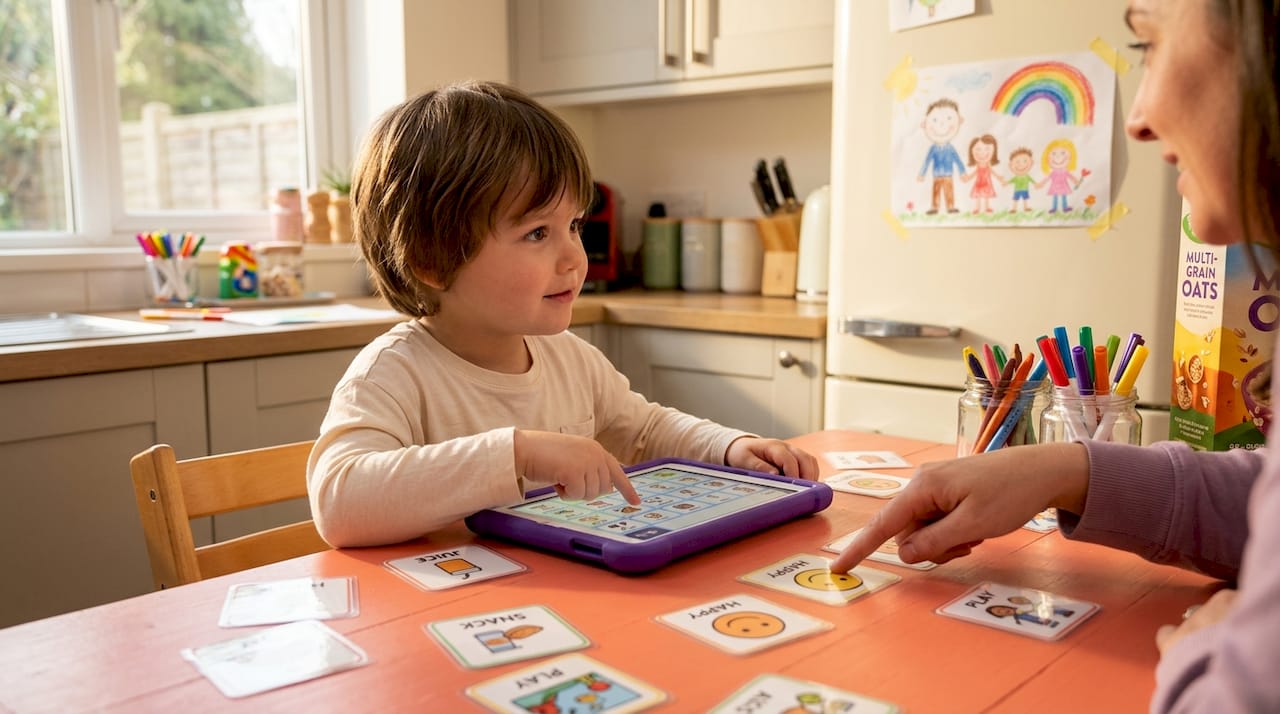
My son, for instance, was much more likely to reference me through sound than through eye contact. A quick sound or a touch rather than a glance across the room. Once I understood that, I stopped worrying that he was not connecting and started understanding how he was connecting.
Here is what parents and educators might notice in neurodiverse children:
- Reduced eye contact during look-backs. A child might seek reassurance through touch, sound, or proximity rather than direct eye contact.
- Delayed or atypical checking-in. Some children may check in less frequently, or at different moments in an activity than you might expect.
- Difficulty processing mixed signals. If tone and facial expression do not match (think cheerful words delivered with a tense face), some children find this much harder to read.
- Sensory overload affecting availability. When a child’s sensory thresholds are already stretched, they have less capacity to process social cues from caregivers on top of everything else.
- Strong responses to negative cues. Even when referencing is less frequent, negative caregiver expressions often carry a disproportionately strong effect.
Pro Tip: For children who use PECS or AAC systems, consider how you can make your emotional cues more explicit. Pairing a clear, exaggerated facial expression with a simple verbal label like “safe” or “exciting” can give these children more to work with than subtle cues alone.
Everyday examples of social referencing
Recognising social referencing in the moment is genuinely useful. When you know what to look for, you can make the most of these tiny windows. Here are some real, everyday situations parents and educators encounter all the time:
-
The hesitant toddler at the park. Your child spots a new piece of equipment and stops. They glance back at you. If your face says, “Go on, it looks great!”, they often step forward. If you look tense or uncertain, they may cling or back away. This is caregiver emotional signalling doing its job in real time.
-
The stranger at the school door. A child meets a new teaching assistant for the first time. They look to their parent’s face for a read. A warm, reassuring expression from the parent signals that this person is safe, which gives the child permission to relax and engage.
-
The visual cliff moment. The classic research example involves a glass surface over an apparent drop. Babies used caregiver expressions to decide whether to crawl over it. When caregivers looked happy, most babies crossed. When caregivers looked afraid, almost none did. The emotional signal shaped a physical decision.
-
The sensory play tray. A child approaches a tray of slime or wet sand and freezes. They look at the adult sitting nearby. If the adult touches it first with obvious delight, the child is far more likely to have a go. If the adult looks hesitant or says “ugh, it’s messy”, the child may refuse entirely, even if the texture itself was fine.
-
The meltdown trigger moment. Just before a child reaches overwhelm, some neurodiverse children show a brief, overlooked social referencing moment. A quick look toward a caregiver or key adult as if checking whether anyone has noticed they are struggling. Catching that glance and responding calmly can sometimes reduce the intensity of what follows.
Each of these moments is a chance for you to act as a steady emotional anchor. That is exactly what children are looking for when they glance your way.
Supporting social referencing in neurodiverse children
Parents and educators often ask what they can actually do to nurture social referencing skills, particularly when a child’s processing differences make it harder to read or respond to cues in the typical way. The good news is that a lot of it comes down to consistency, clarity, and reducing noise in the environment so the signal you are sending is easier to receive.
Here are some approaches that genuinely help:
- Keep your emotional signals clear and consistent. Exaggerated but authentic expressions, a big smile, a look of calm curiosity, a gentle “ooh, what’s this?” tone, give children more to work with. Ambiguous or conflicted signals, where your face says one thing and your voice says another, are far harder for many neurodiverse children to decode.
- Get to their level physically. Kneeling down so your face is in their eyeline makes your expressions more accessible, particularly for children who do not automatically seek out faces at adult height.
- Reduce sensory overwhelm first. A child whose sensory threshold is already maxed out simply cannot process social cues reliably on top of that. Regulating the environment (dimming lights, reducing noise, offering a familiar comfort object) creates space for social referencing to happen at all.
- Use consistent, named emotional cues. Labelling your own emotions out loud, for example, “I’m feeling calm and happy,” gives children a verbal anchor to pair with what they are reading on your face. For children using PECS or AAC, linking emotion symbols to your expression reinforces the message.
- Practise in low-stakes moments. Structured play sessions, sensory activities with a familiar adult nearby, and routine group activities all give children repeated, gentle opportunities to practise checking in and reading cues without pressure.
- Celebrate the small moments. When a child looks at you and responds to your cue, even if it is through touch or a sound rather than eye contact, that is social referencing. It counts. Recognising it and mirroring warmth back reinforces the behaviour.
Progress rarely looks like a sudden leap. For most neurodiverse children, it looks like one more glance, one more moment of checking in, one more tiny bit of trust built over time. That is still progress. If you are concerned that your child shows very little social referencing or has seemed to lose skills they previously had, speaking to your health visitor, paediatrician, or a child therapy specialist is a worthwhile step.
Social referencing versus related concepts
Parents watching their children closely sometimes wonder whether what they are seeing is social referencing, joint attention, or just their child picking up on the general mood in the room. These are related but meaningfully different things.
| Concept | What it involves | Typical example | When it emerges |
|---|---|---|---|
| Social referencing | Using a caregiver’s emotional cues to decide how to respond to something new | Baby glances at parent before touching a new toy | 8 to 12 months |
| Joint attention | Sharing focus on the same object or event with another person | Child points at a bird and looks to see if you are looking too | 9 to 18 months |
| Mood contagion | Automatically absorbing and mirroring the emotional tone of those nearby | Child becomes tearful in a room full of upset adults | Present from birth |
The key distinction is purpose. Social referencing is active and intentional: the child is seeking information. Joint attention is about sharing an experience. Mood contagion is largely unconscious, it is emotional weather you pick up without meaning to. Social referencing adds an emotional interpretation that joint attention alone does not include.

For neurodiverse children, these lines can blur a little. A child who engages strongly with mood contagion but struggles with intentional social referencing may still be picking up on your emotional state, just through a different route.
My honest experience as a parent
I want to be straight with you: I had never heard the term social referencing until my son was well past the age when it typically emerges. Once I understood it, though, I could see it everywhere in our history together. Every time I had unknowingly pulled a slightly anxious face at something messy and watched him back away. Every tense mealtime where my stress was radiating off me and landing squarely on him. Knowing what social referencing is did not make me feel guilty. It made me feel useful, like I finally had a tool that actually worked.
What shifted for us was slowing down. Instead of scanning the room or looking at my phone during play, I started positioning myself so he could find my face easily if he needed to. I made my expressions bigger and clearer. I narrated my own calm out loud. And gradually, I started seeing those tiny glances that I had been missing all along.
The thing I would tell any parent is this: your child is watching you more carefully than you realise. They are not doing it to put pressure on you. They are doing it because you are their safest source of information in a world that can feel genuinely overwhelming. That is not a burden. That is a relationship.
— Anthony
Sensory play that supports social referencing
At Fidgetandspin, our sessions are built around exactly these kinds of moments. We create small, calm environments where neurodiverse children aged 1 to 7 can explore at their own pace, with familiar, warm adults nearby offering clear, consistent emotional cues throughout. Every session at our sensory stay-and-play includes themed sensory zones and gentle group activities designed to give children repeated, low-pressure chances to practise reading social cues and checking in with trusted adults.
We see it every week: a child hesitating at the edges of a new activity, glancing at a parent or our session leader, and then deciding to give it a go because the face they see looks genuinely delighted. Those moments are not small. They are the building blocks of emotional confidence.
If you want to understand more about how our sessions work and how we support social development through sensory play, take a look at what a typical session looks like. And if you are ready to come along, you can join our waitlist to secure a space for your little one.
FAQ
What is social referencing in simple terms?
Social referencing is when a young child looks to a trusted adult’s face or tone to decide how to react in an unfamiliar or uncertain situation. It is how babies and toddlers use caregivers as emotional guides.
At what age does social referencing begin?
Children typically begin social referencing between 8 and 12 months of age, when they start actively seeking out caregivers’ emotional reactions to new objects or situations.
Do autistic children use social referencing?
Some autistic children show social referencing differently, such as through touch or proximity rather than eye contact, but the drive to seek information from trusted adults is still often present. Neurodiverse children may simply need clearer, more consistent cues to support the process.
Why does my child respond so strongly to my stress?
Negative emotional cues from caregivers tend to have a stronger effect on children’s behaviour during social referencing than positive ones, which is why your stress can land so heavily even when you have not said a word.
How is social referencing different from joint attention?
Joint attention involves two people sharing focus on the same thing, whereas social referencing specifically involves a child seeking emotional guidance about how to respond to that thing. Social referencing adds an emotional layer that joint attention alone does not include.