
TL;DR:
- Understanding vestibular input reveals it is crucial for balance, alertness, and emotional regulation in children.
- Children process vestibular signals differently, leading to seeking or avoiding movement, impacting daily functioning.
- Supporting vestibular needs through intentional play enhances regulation and development, especially in neurodiverse children.
You’ve probably watched your child spin until they fall over, demand to be pushed on the swings for the fifteenth time, or go completely rigid at the top of a slide. And if you’re anything like I was, you either Googled “why does my child never stop moving” or sat in a waiting room being handed leaflets that explained nothing useful. Understanding what is vestibular input changed how I see Remy’s body and behaviour. Not as a problem to fix. As a system trying to do its job.
Table of Contents
- Key takeaways
- What is vestibular input: the basics in plain English
- How vestibular input shapes development in neurodiverse children
- Recognising vestibular processing differences at home
- Supporting vestibular needs at home and in daily routines
- Vestibular input as part of the bigger picture
- What I’ve actually learned along the way
- Sensory sessions built around how your child actually moves
- Common questions
Key takeaways
| Point | Details |
|---|---|
| Vestibular input is sensory information | The vestibular system detects head position and movement, feeding the brain data it needs for balance and coordination. |
| It affects more than balance | Vestibular processing also shapes alertness, emotional regulation, and the ability to concentrate and sit still. |
| Neurodiverse children process it differently | Some children seek intense movement; others avoid it. Both responses signal a nervous system doing its best. |
| Activities can be tailored at home | Swinging, rocking, spinning, and rough-and-tumble play all provide vestibular input with no specialist equipment needed. |
| Professional support is available | Occupational therapists can assess vestibular processing and recommend a sensory diet suited to your child’s specific profile. |
What is vestibular input: the basics in plain English
The vestibular system lives in the inner ear. That is where the magic and, honestly, a lot of the confusion starts. Most people think ears are just for hearing. They are also the brain’s motion sensor.
Vestibular input is sensory information that tells the brain where the head is in space and how it is moving. Every tilt, roll, spin, and change in speed sends a signal up to the brain. The brain uses that information constantly, even when your child is simply sitting on the floor.
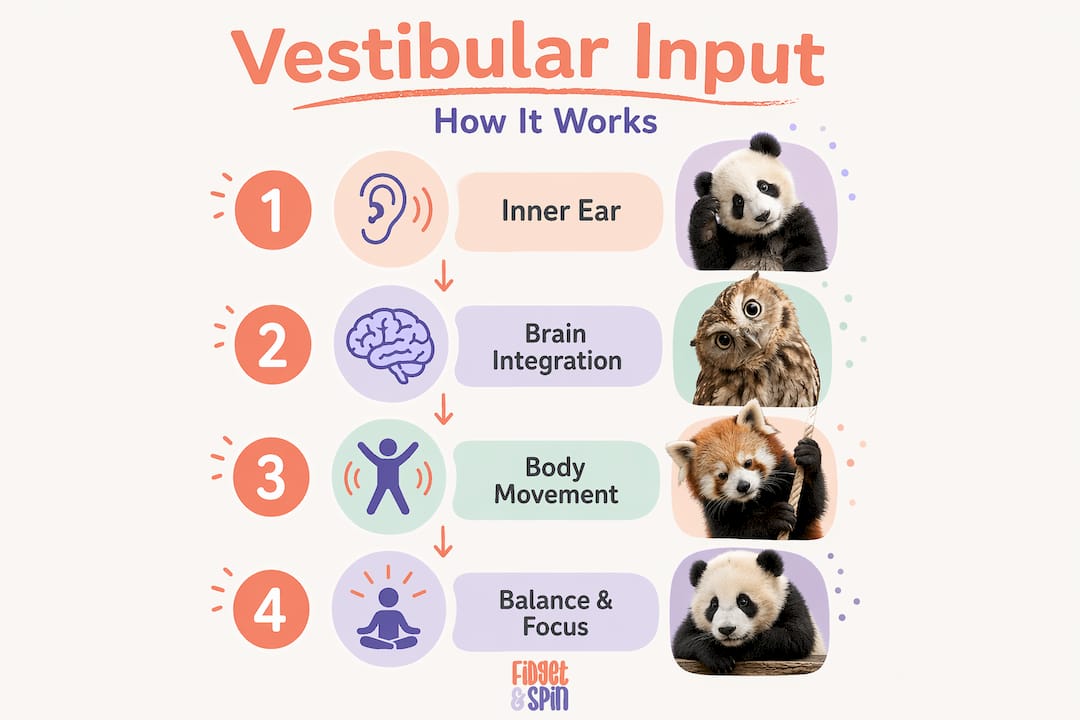
The vestibular apparatus has two main parts. The otolith organs detect linear movement and head tilt. So when your child tips their head sideways to watch something, or runs in a straight line, the otolith organs are firing. The semicircular canals detect rotation around three different axes. Spinning, rolling, and cartwheeling are their territory.
Here is a quick breakdown of the two types of vestibular information:
- Linear and tilt input (otolith organs): swinging in a straight line, going up and down on a see-saw, nodding the head, tilting sideways
- Rotational input (semicircular canals): spinning in circles, rolling down a hill, turning the head quickly, somersaults
The brain does not handle vestibular information in isolation. It integrates vestibular signals with what the eyes see and what the muscles and joints feel (that is proprioception) to maintain balance and coordinate movement. Think of it as a three-way conversation happening in real time, every moment your child is awake.
| Vestibular organ | Type of movement detected | Example activity |
|---|---|---|
| Otolith organs | Linear acceleration, head tilt | Swinging forward and back, nodding |
| Semicircular canals | Rotation about three axes | Spinning, rolling, turning |
| Both together | Complex full-body movement | Climbing, rough-and-tumble play |
How vestibular input shapes development in neurodiverse children
Remy was about three when I first noticed he would seek out the swing before anything else at the park and then, only then, be calm enough to manage the rest of the visit. At the time I thought he just liked swinging. Turns out it was a bit more considered than that, even if he had no language for it.
Vestibular input does not just help children stand upright. It organises sensory responses so that the nervous system can regulate its own alertness. Slow, rhythmic movement tends to calm. Fast, unpredictable movement tends to alert. That is why a rocking chair works at bedtime and a trampoline works when a child needs to wake up and focus.

For neurodiverse children, vestibular processing can look quite different. Differences in vestibular and proprioceptive processing can show up as challenges with postural control, coordination, or sensory-motor planning. These are not character flaws or attention-seeking. They are a nervous system processing movement differently to what most environments expect.
These differences affect everyday life in ways that are easy to miss:
- Difficulty sitting still at a table or on the floor during group activities
- Struggling with activities that require balance, like dressing or using stairs
- Needing constant movement to stay regulated and focused
- Becoming distressed or rigid when unexpectedly moved or tipped (a car seat recline, for example)
- Seeking spinning, rocking, or swinging beyond what peers seem to need
It is also worth knowing that vestibular-proprioceptive integration matures between roughly seven and ten years of age. So for children aged one to seven, this system is genuinely still developing. Some of what looks like clumsiness or over-the-top movement seeking is simply a system that is not fully online yet. That framing takes a lot of pressure off, I find.
Pro Tip: If your child seems better regulated after physical play, that is not coincidence. Movement is medicine for the vestibular system. Build it in before tasks that require sitting or concentrating, rather than as a reward after.
Recognising vestibular processing differences at home
I have sat across from professionals who described Remy using words I had to look up later. What I actually needed was someone to describe what it looked like on a Tuesday morning in our kitchen.
Vestibular processing differences tend to show up in one of two directions: seeking or avoiding. Neither is more “severe” than the other. They are just different presentations of a system that is not registering movement in the same way as the majority.
Signs your child may be seeking vestibular input:
- Constant spinning, rocking, or swinging, often self-generated
- Craving rough-and-tumble or being swung vigorously
- Needing to move to concentrate, for example rocking on a chair or fidgeting
- Seeking fast, intense movement like jumping off furniture or running into things
- Difficulty sitting still in any context, even preferred activities
Signs your child may be avoiding or over-responding to vestibular input:
- Distress when feet leave the ground, even slightly
- Refusing swings, slides, or anything that involves tipping the head back
- Grabbing at adults or furniture for security on uneven surfaces
- Becoming overwhelmed or upset in lifts, cars, or escalators
- Avoiding physical play that involves rotation or unpredictable movement
The important thing to notice is functional impact, not frequency. Plenty of children spin for fun without it meaning anything clinically. What matters is whether the behaviour is affecting the child’s ability to play, learn, eat, sleep, or feel at ease. The nervous system adjusts its sensory weighting moment to moment depending on environment and demands, which explains why your child might be fine on the swings on Friday and completely overwhelmed by them on Saturday. That variability is real. It is not inconsistency or manipulation. Trust what you observe across time.
Supporting vestibular needs at home and in daily routines
Once I understood what vestibular input actually was, I stopped feeling like I was guessing. I started offering movement with intention rather than hoping for the best.
Here are some practical ways to weave vestibular activities into everyday life:
- Swinging. Back and forth (linear) movement is one of the most regulating vestibular inputs available. A garden swing, an indoor hammock swing, or even a blanket swing held by two adults all work well.
- Rocking. A rocking chair, a rocking horse, or simply rocking a child on your lap provides slow, rhythmic linear input. Brilliant before meals or transitions.
- Spinning. Office chairs, spinning tops (if your child fits), or being gently spun provide rotational input. Watch your child’s response carefully and stop before they seem overwhelmed.
- Rolling. Rolling across a soft surface, somersaults with support, or log rolls on the floor engage both the otolith organs and semicircular canals together.
- Balance activities. Walking along a low wall, balance boards, stepping stones, or wobble cushions all challenge the vestibular system without requiring equipment that costs a fortune.
- Rough-and-tumble and big movement play. Being lifted, tipped gently, spun in an adult’s arms. These are vestibular activities in disguise, and children often seek them out instinctively.
Pro Tip: Different activities target different parts of the vestibular system. Swinging and rocking engage the otolith organs (linear movement), while spinning engages the semicircular canals (rotation). If your child seeks one and not the other, that is useful information for their sensory profile.
On the safety side: always follow your child’s lead and watch for signs of overstimulation. Flushed cheeks, sudden pallor, nausea, or an abrupt shift to distress all signal it is time to slow down or stop. If you are uncertain about your child’s specific sensory profile, an occupational therapist who specialises in sensory integration can provide an assessment and a tailored sensory diet. That personalised input is genuinely worth seeking.
Vestibular input as part of the bigger picture
No single sense operates alone. That is one of the things that took me the longest to absorb. I kept trying to isolate the vestibular piece as though fixing that would fix everything. It does not work that way.
The vestibular system interacts constantly with proprioception (the sense of body position and force), vision, and other sensory systems. Understanding how vestibular and proprioceptive processing work together helps explain why some children need both movement and pressure to feel regulated, not one or the other. You will also find that sensory integration strategies tend to be most effective when they account for all the sensory systems rather than treating vestibular input as a standalone fix.
Here is a useful comparison of the sensory systems most relevant to neurodiverse children in early years:
| Sensory system | What it detects | How it supports development |
|---|---|---|
| Vestibular | Head movement, position, balance | Coordination, posture, arousal regulation |
| Proprioceptive | Body position, muscle force, joint pressure | Motor planning, body awareness, calming |
| Tactile | Touch, texture, temperature | Social bonding, fine motor skills, sensory comfort |
| Visual | Light, movement, spatial relationships | Navigation, focus, environmental awareness |
Early vestibular support does not need to look clinical. It can look like a good play session. What matters is that the movement is responsive, consistent, and attuned to the child rather than following a rigid protocol. Children’s sensory systems are still developing through early childhood, and the most powerful thing you can offer is a parent who is paying attention and adjusting as they go. You are already doing that. You are here, reading this.
What I’ve actually learned along the way
I remember the first time an OT used the word “vestibular” with me. I nodded and then went home and cried a little, because I had had Remy for four years and I did not know the word for something he had been telling me with his whole body every single day.
What I’ve since learned is that theory is not the whole picture. Remy’s vestibular needs shifted with his environment, his anxiety levels, whether he had slept, and roughly a hundred other variables I cannot always predict. There were weeks when the swing was the only thing that helped us get through the afternoon. There were other weeks when it ramped him up and left us both frazzled.
The version of vestibular support that has worked for us is not the one from the handout. It is the one I built by watching him closely and being willing to change the plan on a Tuesday. Professional advice matters enormously, and I am not suggesting you ignore it. What I am saying is that your observations are data too. You know your child’s nervous system in a way no one else does, simply from the accumulation of ordinary days.
I have also found that naming the system, understanding that Remy’s body is processing vestibular signals differently rather than choosing chaos, has made me a more patient parent on the difficult days. Not always. But more often than before.
— Caitlin
Sensory sessions built around how your child actually moves
At Fidget and Spin, Anthony and I built something we desperately needed when Remy was small. Our weekly sessions in Brighton and Hove are designed specifically for neurodiverse children aged one to six, across three sensory zones. The Wiggle and Bounce zone is where vestibular input gets a proper workout. Think spinning, bouncing, climbing, and rolling with no pressure to do it quietly or calmly or in a straight line. We have also hosted sensory birthday parties for ages one to seven across Brighton, Hove, and wider Sussex, for families who have spent too long dreading the standard party venue.
If any of this resonates, come and have a look at our sensory sessions and see how we structure them. Families tell us they often feel like they can breathe for the first time in a session. That is not marketing speak. That is what it looks like when the space was designed for your child.
Common questions
What does vestibular input mean?
Vestibular input is sensory information from the inner ear that tells the brain about head position, movement, and balance. It supports coordination, posture, and arousal regulation.
Why do some children crave constant spinning or swinging?
Children who seek intense movement may have a nervous system that requires more vestibular input to feel regulated. This is sometimes called vestibular seeking and is common in autistic and ADHD children.
How does vestibular input affect a child’s ability to sit still?
The vestibular system helps regulate alertness. Without adequate vestibular input, some children find it genuinely difficult to stay seated and focused, as their nervous system is using movement to self-organise.
Can vestibular processing difficulties be supported at home?
Yes. Activities like swinging, rocking, rolling, and balance play all provide vestibular input and can be built into daily routines. For tailored support, an occupational therapist with sensory integration training is the best next step.
At what age does vestibular processing mature?
Research indicates that vestibular and proprioceptive integration continues developing until around seven to ten years of age, which means processing differences in early childhood are often part of an ongoing developmental process rather than a fixed condition.
Recommended
- What is proprioception? A guide for SEN parents | Fidget and Spin Brighton
- What is proprioceptive input: a parent’s guide | Fidget and Spin Brighton
- What is SEN? Understanding support for your child in Brighton | Fidget and Spin Brighton
- What is SEN? Understanding support for your child in Brighton | Fidget and Spin Brighton