
TL;DR:
- True social inclusion involves active participation, equitable access, and valuing each child’s unique needs beyond mere presence.
- It requires ongoing commitment, adaptable environments, trained adults, and supportive peer interactions to foster genuine engagement.
“Your child is welcome here.” It’s a phrase that sounds reassuring, but have you ever walked into a setting and quickly realised that welcome meant tolerated rather than truly included? For families of neurodiverse children aged 1 to 7, this gap between presence and participation is something many of us feel in our bones, even when we struggle to put it into words. Social inclusion is more than physical presence; it emphasises equal opportunity and tackling discrimination at every level. Understanding what genuine inclusion looks like, and why it matters, can completely change the choices you make for your child.
Table of Contents
- Defining social inclusion: More than just being present
- Social inclusion in early childhood: The policy and practice connection
- Inclusive play strategies: Evidence-based approaches that work
- The role of environment and play activity: Making inclusion real
- A fresh perspective: Inclusion means real participation, not just presence
- Next steps: Support your child’s social inclusion journey
- Frequently asked questions
Key Takeaways
| Point | Details |
|---|---|
| True inclusion means participation | Social inclusion is about every child having an active role and voice, not just being present. |
| Environment and activity matter | Hands-on and outdoor activities often boost peer interaction for neurodiverse children. |
| Adult support is crucial | Trained staff and intentional strategies make meaningful participation possible in inclusive settings. |
| Trial different play types | Try a range of activities to find what best encourages your child’s social engagement. |
Defining social inclusion: More than just being present
Let’s get specific about what social inclusion really means and why it is so much more than being “in the room.”
There is an important distinction that often gets blurred: integration versus inclusion. Integration means your child shares a physical space with their peers. Inclusion means your child participates, has a voice, and is valued in that space. It sounds like a small difference on paper. In practice, it is enormous.
“Inclusion is not simply about access or placement. It is an aspiration, a process, and a practice that ensures equitable access, participation, and voice for every child, especially those facing systemic barriers.” Global Disability Inclusion Report, UNICEF
This framing from the Global Disability Inclusion report is so important. It tells us that true inclusion is not a destination you arrive at once the ramp is installed or the sensory corner is set up. It is an ongoing commitment.
Think about the inclusive term meaning itself: it comes from the idea of encompassing everything, leaving nothing out. Applied to your child, it means their communication style, sensory needs, and way of engaging with the world are not obstacles to work around. They are part of the fabric of the group.
Integration vs. inclusion: A comparison
| Attribute | Integration | Inclusion |
|---|---|---|
| Focus | Physical presence | Active participation |
| Approach | Fitting the child to the setting | Adapting the setting to the child |
| Communication | One-size-fits-all | Multiple formats and methods |
| Child’s voice | Rarely prioritised | Central to decisions |
| Adult role | Supervision | Active scaffolding and support |
| Outcome measure | Attendance | Engagement and wellbeing |
Social inclusion is a process aimed at improving participation in social, economic, and political life by ensuring equal opportunity and tackling discrimination. For our children, this translates to something very tangible: are they actually part of what is happening, or just nearby while it happens?
Signs of true social inclusion in an early childhood setting
- Adults use multiple communication tools, including visual supports, AAC devices, and Makaton
- Activities are adapted so every child can engage at their own level
- Children’s responses, including non-verbal ones, are noticed and valued
- Peer interactions are gently scaffolded, not left entirely to chance
- The environment accounts for sensory thresholds, not just physical access
- Families are consulted and kept genuinely informed
You can see how our sessions work at Fidget and Spin to get a sense of what this looks like in a real setting designed with neurodiverse children at the centre.
Social inclusion in early childhood: The policy and practice connection
With a foundational definition in place, we can now explore how inclusion is put into practice in early years and why specific support matters.
Policy shapes practice, often in ways parents cannot immediately see. UNICEF defines inclusive education as all children learning together, backed by teacher training, accessible resources, and a conscious effort to reduce stigma. When a nursery or playgroup genuinely commits to this, it changes what happens moment to moment in the room.
What mainstream versus inclusive pedagogy looks like for neurodiverse children
| Feature | Mainstream approach | Inclusive approach |
|---|---|---|
| Group activities | Same task for all children | Differentiated by need and ability |
| Communication | Verbal instruction | Visual, tactile, verbal, and symbolic |
| Transition support | Standard warning to all | Personalised cues and routines |
| Peer interaction | Unstructured and self-directed | Gently guided with adult support |
| Assessment | Uniform benchmarks | Individual progress tracking |
| Family involvement | Termly updates | Continuous, two-way dialogue |

The adult role is absolutely critical here. Training matters enormously. A practitioner who understands sensory processing differences will read a child’s withdrawal very differently from one who sees it as non-compliance. Accessible materials, like weighted blankets, visual timetables, and textured play resources, signal that the setting was designed with your child in mind, not adapted reluctantly after the fact.
Steps a setting should take to support inclusion
- Carry out an individual needs assessment before your child attends
- Adapt the physical environment to reduce sensory overwhelm
- Provide staff training in neurodiversity, communication differences, and emotional regulation
- Offer multiple activity formats so children can engage in their own way
- Build peer awareness into the group culture from the start
- Review and adjust support regularly, in partnership with families
This is precisely the kind of intentional, evidence-backed approach that underpins the sensory playgroup approach at Fidget and Spin. Every session is structured to meet children where they are, not where a curriculum says they should be.
Inclusive play strategies: Evidence-based approaches that work
Understanding the bigger picture, let’s turn to practical strategies that have been proven to support social inclusion for young children, especially those who are neurodiverse.
Research is getting increasingly specific about what actually works. Teachers in a 2026 qualitative study described buddy and peer support systems, smaller mixed-ability groups, differentiated grouping, and direct adult guidance as their most effective tools for supporting inclusion in play. These are not abstract ideas. They are things you can look for, ask about, and advocate for in any setting your child attends.
Actionable ways to support inclusion at home and in local settings
- Set up small-group play dates (two or three children at most) rather than large gatherings
- Use a visual schedule so your child knows what to expect during social activities
- Offer hands-on activities, like sensory bins, playdough, or simple crafts, as natural icebreakers
- Role-play social scenarios at home using toys, puppets, or social stories
- Ask your child’s key worker about peer buddy arrangements during group sessions
- Celebrate every form of interaction, including parallel play, as meaningful participation
- Reduce sensory distractions in the environment before social play begins
Pro Tip: Do not assume your child needs to thrive in every type of activity before a setting is “working.” Try several different formats, from music sessions to messy play to quiet craft time, and watch where your child’s engagement naturally sparks. That spark is data. Use it to shape the experiences you seek out for them.
The inclusive play sessions at Fidget and Spin are built around exactly this kind of trialling and responsive adjustment. No two children respond identically, and that is a feature, not a problem.
It is also worth noting the research on peer interaction rates. Children with SEND engage more consistently when activities are chosen with their sensory and motor profiles in mind. Structured but flexible play environments significantly increase the frequency and quality of peer interaction compared with unstructured settings. That is a powerful finding for parents who wonder whether specialist sessions are “worth it” compared to generic community groups.
The role of environment and play activity: Making inclusion real
Strategies become even more effective when paired with the right kinds of environment and activity. Let us see how you can maximise the benefits for your child.
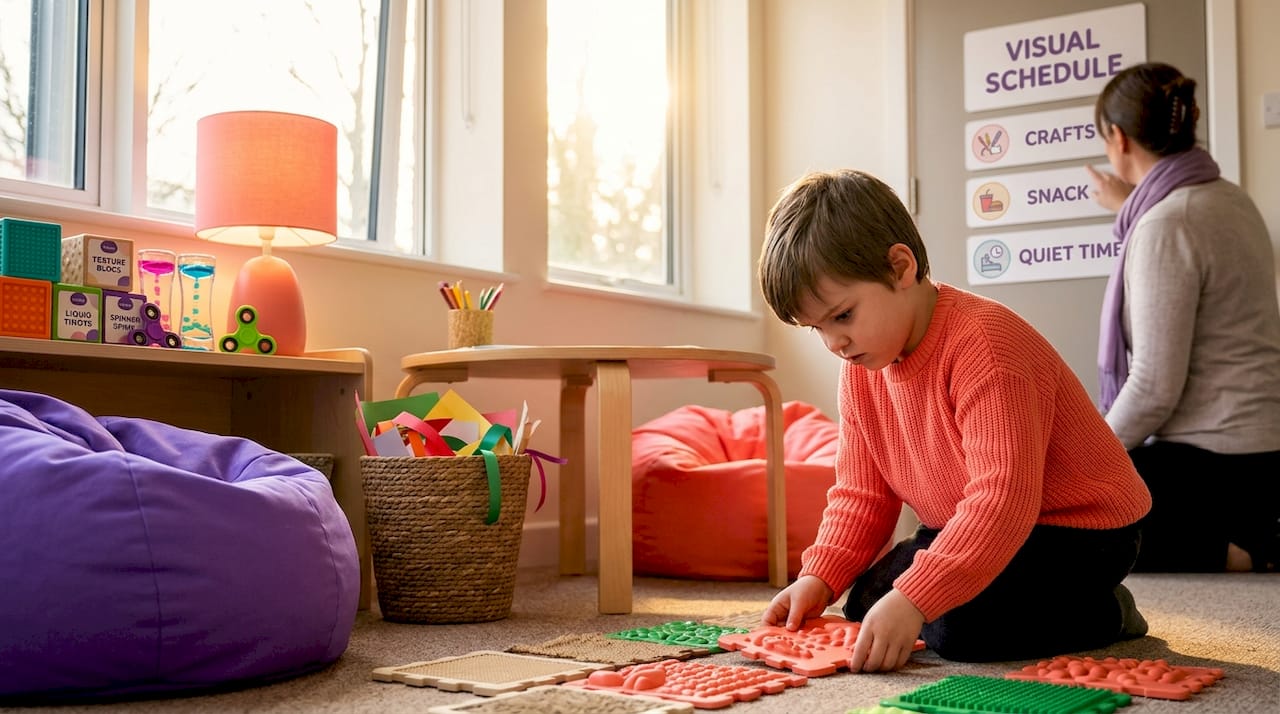
The physical space is not a neutral backdrop. It is an active participant in whether inclusion happens or not. Bright fluorescent lighting, loud echoing spaces, and unpredictable transitions can all push a neurodiverse child’s sensory threshold past the point where social engagement is even possible. You cannot include a child who is in survival mode.
Outdoor and free play in green areas supports more cooperative, less competitive social behaviour, and benefits concentration and social skills. There is something about natural environments, the softer lighting, the varied textures, the gentle unpredictability of wind and leaves, that seems to lower defences and invite curiosity. If your garden or local park is accessible, using it deliberately as a social space can make a meaningful difference.
A 2025 study reported that children with SEND showed higher peer interaction rates during hands-on activities like painting, puzzling, and crafts. This makes intuitive sense. When there is a shared object to focus on, the pressure of direct social interaction eases. The activity becomes a bridge. Children can participate side by side, then gradually alongside each other, then together, all without the intensity of face-to-face interaction from the start.
How to adapt home, garden, and community settings for inclusion
- Create defined activity zones so your child knows where things happen and can choose their level of engagement
- Use soft lighting, natural light, or dimmable lamps to reduce sensory load
- Introduce new social settings gradually, starting with one trusted peer before expanding the group
- Keep backgrounds quieter during play, television off, music low, so communication is easier
- Offer tactile, open-ended materials that invite parallel and cooperative play naturally
- Use visual supports, like picture cards or a simple choice board, so your child can express preferences during group activities
Pro Tip: When you are observing inclusion in action, do not only count how many times a peer approaches your child. Look at whether your child is able to respond, whether the environment supports them to participate, and whether adults are actively enabling engagement. A child who is quietly watching but emotionally regulated and visually tracking is participating. That counts.
A fresh perspective: Inclusion means real participation, not just presence
Here is something I genuinely believe, drawing on everything the research says and everything our community experiences: a lot of settings are still confusing access with inclusion, and it is costing our children.
Putting a child in a room and calling it inclusion is like putting a book in front of someone and calling it reading. The conditions for genuine engagement have to be there. That means trained adults, adapted environments, peer support structures, and a culture that values every child’s contribution, however it looks.
Social inclusion should be assessed by participation and the quality of supports available, not only by whether peers self-initiate interaction with your child. This is a really important distinction for parents to hold onto. If the measure of success is “did other kids come to play with them?”, we are placing the entire burden of inclusion on social spontaneity and missing the structural supports that make inclusion possible in the first place.
“Genuine inclusion requires us to look beyond attendance figures and peer-initiated contact, and ask instead: does this child have what they need to participate on their own terms?”
When you visit a setting, ask the hard questions. How do you support children who use AAC? What does your peer support structure look like? How do you adapt when a child’s sensory needs change week to week? The answers will tell you everything.
The sensory playgroup experience at Fidget and Spin is built on the belief that every child’s way of being in the world is valid. Not just accommodated. Valued. That is a different thing entirely, and it is the thing our children deserve.
Pro Tip: When choosing a setting, ask specifically: “What does peer support look like here, and how do you differentiate activities for children with different sensory profiles?” A setting that can answer that question clearly and warmly is one that has genuinely thought about inclusion.
Next steps: Support your child’s social inclusion journey
Ready to put these ideas into action? Here is how you can find supportive, inclusive play designed specifically for your family.
At Fidget and Spin, we have built every session around the evidence: small groups, hands-on activities, sensory-aware environments, and adults who understand neurodiversity from the inside out. We are not a mainstream setting with a ramp added on. We are a space where inclusion is the entire point.
Whether your child is just beginning their social play journey or you are looking for a community that truly gets it, we would love to welcome you. You can book a sensory play session to try it for yourself, or if spaces are limited in your area, join the waitlist and we will be in touch as soon as a place opens up. Want to know more before you commit? Learn more about Fidget and Spin and discover how our themed sensory zones and guided activities are designed to support communication, confidence, and real social participation for neurodiverse children aged 1 to 7.
Frequently asked questions
What is the difference between integration and social inclusion?
Integration is about being present in the same space, while social inclusion focuses on meaningful participation and equitable access to opportunities, ensuring every child can engage on their own terms.
How can I tell if a playgroup is genuinely inclusive?
Look for settings where adults actively scaffold all children’s participation, offer multiple activity types, and value non-verbal communication. Peer support systems and mixed-ability groupings are strong indicators of a genuinely inclusive approach.
Do certain activities help my neurodiverse child join in more?
Yes. Hands-on activities like painting, crafts, and puzzling have been shown to boost peer interactions for children with SEND, because shared objects reduce the pressure of direct social engagement.
Why is outdoor play highlighted in inclusion research?
Outdoor and free play settings are linked with better social skills, more cooperative behaviour, and less competition among young children, making them naturally supportive environments for neurodiverse learners.
What questions should I ask when choosing an inclusive playgroup?
Ask about peer support strategies, how they adapt activities for different sensory and communication needs, and what training practitioners have in neurodiversity. Clear, confident answers to these questions are a strong sign of a setting that has genuinely prioritised inclusion.