
TL;DR:
- Mainstream play groups often lack sensory-friendly environments and trained support for neurodiverse children. These settings are usually built around unstructured, high-stimulation activities that can cause overstimulation and exhaustion. Specialist SEN groups, with lower capacity and sensory zoning, provide authentic engagement and sense of belonging for neurodiverse children and their families.
Mainstream play groups are frequently unsuitable for neurodiverse children because they lack the sensory-friendly environments and specialist support these children need. If you have ever sat in a church hall watching your child press themselves against the wall while every other toddler charges about, you already know this. The reasons why mainstream play groups don’t work for SEN families go deeper than noise levels or a lack of beanbags. They are structural. They are about staffing, design, and a set of unspoken social rules that were never written with our children in mind. Understanding those reasons is the first step towards finding something that actually works.
Why mainstream play groups don’t work for SEN families
The core problem is environment. Most mainstream playgroups are built around the assumption that children regulate themselves through movement, noise, and peer interaction. For many neurodiverse children, that combination does the opposite of regulate. Mainstream play environments are often high-stimulation, with loud noise and chaotic free play, and they lack the low-stimulation zones that neurodiverse children need to recover and re-engage.
The result is not just a difficult hour. Overstimulation from environments comparable to a heavy rock concert can take children hours to recover from, affecting sleep and family routines the following day. That is a full-day cost for a one-hour session. Most parents I know stopped going not because they gave up, but because the recovery simply was not worth it.
How sensory overload shapes a child’s experience in mainstream groups
Sensory processing differences mean that ordinary playgroup inputs, the scraping chairs, the shrieking, the unpredictable movement of other children, arrive at a much higher intensity for many neurodiverse children. What feels like background noise to a neurotypical child can feel physically painful to a child with sensory processing differences.
The specific triggers matter:
- Noise: Group singing, clapping games, and echoing halls create sudden, unpredictable sound spikes.
- Crowds: Unstructured free play means bodies moving in all directions with no warning.
- Texture and touch: Shared craft materials, sand trays, and messy play without opt-out options force sensory contact.
- Transitions: Abrupt tidy-up times with no visual or auditory warning cause significant distress.
- Lighting: Fluorescent lighting in community halls creates flicker and glare that many children find intolerable.
Each of these is manageable in isolation. Together, they create an environment where a child spends the entire session in a state of high alert rather than play. Dysregulation is not a behaviour problem. It is a physiological response to an environment that was not designed for that child’s nervous system.
Pro Tip: If you are trialling a mainstream group, arrive early before the noise builds and identify a quieter corner before your child enters the main space. It does not fix the structural problem, but it buys time.
The learning through play benefits that playgroups are supposed to deliver simply do not reach a child who is spending all their energy on survival rather than exploration.
What staffing gaps mean for SEN children in mainstream settings
Walk into most mainstream playgroups and you will find one or two volunteers managing fifteen to twenty children. That ratio is not a criticism of those volunteers. It is a structural reality that makes individualised support impossible. Staff-to-child ratios in mainstream settings can reach 1:30 or 1:40 in some contexts. At that ratio, a child who needs a calm co-regulation moment, a visual schedule check, or an AAC communication prompt simply does not get it.
The training gaps compound the ratio problem. Most mainstream playgroup staff and volunteers have no specific training in:
- Autism spectrum conditions and sensory processing differences
- AAC systems including PECS or symbol-based communication
- PDA (Pathological Demand Avoidance) profiles and low-demand approaches
- Recognising the difference between dysregulation and deliberate behaviour
- De-escalation techniques that do not rely on verbal instruction
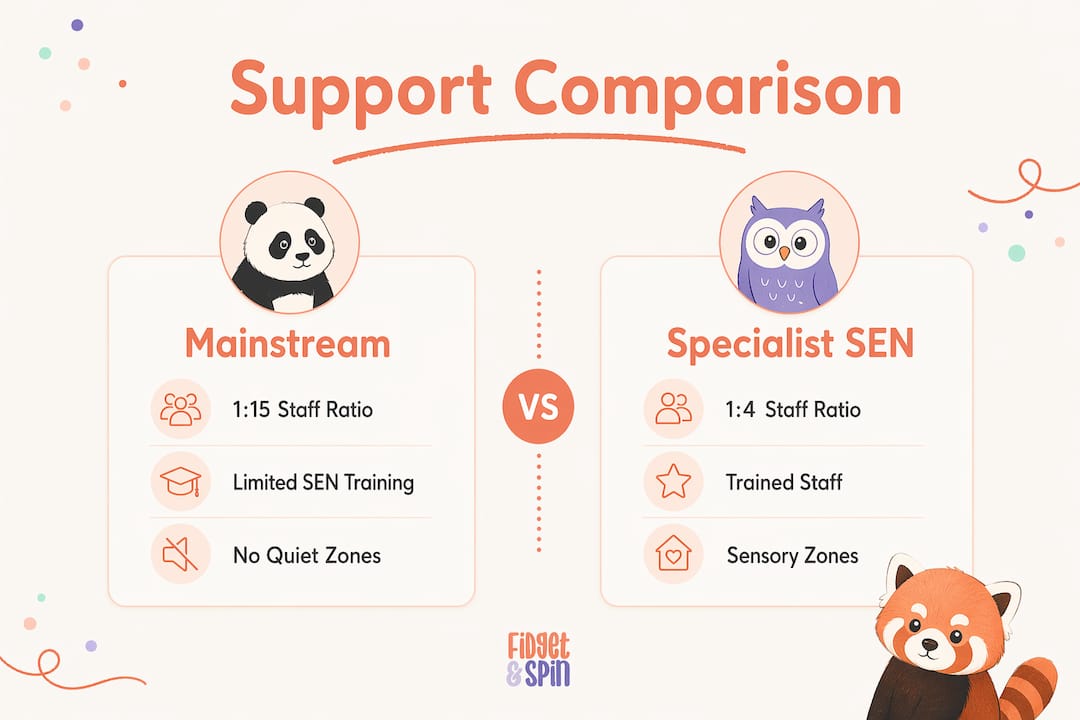
The table below shows how mainstream and specialist settings typically differ in the support they provide.
| Support factor | Mainstream playgroup | Specialist SEN group |
|---|---|---|
| Staff-to-child ratio | Often 1:15 or higher | Typically much lower, allowing 1:1 moments |
| Sensory environment design | Standard community hall | Deliberately low-stim with quiet zones |
| Staff SEN training | General early years only | Autism, AAC, sensory, PDA-informed |
| Communication support | Verbal instruction | Visual schedules, PECS, AAC-compatible |
| Unstructured play management | Child-led with minimal guidance | Scaffolded with parallel play options |
Specialist settings support language, communication, and self-advocacy skills in ways that mainstream groups simply cannot replicate at scale. That is not a failure of goodwill. It is a failure of design.
What social exclusion actually feels like for SEN parents and children
The sensory and staffing problems are visible. The social ones are quieter and, in some ways, harder to carry. Parents of neurodiverse children frequently report feeling pressured to explain or apologise for their child’s behaviour repeatedly in mainstream groups. The side-eye when your child stims. The well-meaning parent who suggests your child “just needs more socialising.” The group leader who tells you your child is “doing so well” when what they mean is “they were quiet today.”
“True inclusion requires conscious design beyond just physical presence. It means eliminating the pressure for neurodiverse children to mask and conform, and educating the whole community, not just expecting minority families to manage social difficulties alone.”
Masking is the process by which neurodiverse children suppress their natural responses to fit in. It is exhausting, and the cost of masking shows up at home, not at the group. Your child holds it together for an hour and then falls apart the moment you get through the front door. Other parents see a child who “managed fine.” You see the aftermath.
The social gatekeeping is real too. Playgroups have their own unspoken hierarchies. Parents bond over shared milestones. When your child’s milestones look different, or when your child does not engage in the expected way, you find yourself on the outside of those conversations. What social inclusion really means for neurodiverse children is not physical presence in a room. It is belonging. Mainstream groups rarely deliver that.
Pro Tip: If your child is masking at a group, the group is not working for them, regardless of how “well” they appear to others. Regulated, authentic play looks different from performed compliance.
What makes specialist SEN play groups work better
The difference between a mainstream group and a well-run specialist SEN group is not just the sensory setup. It is the entire philosophy. SEN-focused stay-and-play groups typically offer lower-capacity sessions, with families reporting lower social anxiety and a genuinely no-judgement environment for both child and parent.
Effective specialist groups share several features:
- Low capacity: Smaller numbers mean less noise, less unpredictability, and more staff attention.
- Sensory zoning: Separate areas for big movement, quiet retreat, and tactile play allow children to self-select their input level.
- Parallel play as the default: Children engage more deeply when allowed independent play within a safe, sensory-managed space rather than being pushed into group interaction.
- No-judgement culture: Parents do not explain or apologise. Everyone in the room already understands.
- Trained staff: Sessions are led by people who recognise dysregulation, know how to support AAC users, and understand PDA profiles.
Cost is a genuine barrier for many families. SEN-focused groups in some UK regions charge around £3–£5 per session, making them accessible alongside NHS and local authority support. That pricing reflects a deliberate choice to keep sessions within reach of families who are already managing significant additional costs.
Specialist settings are not a consolation prize for children who could not manage mainstream. They are often the environment where neurodiverse children first experience genuine, unforced connection. That matters enormously for confidence, communication, and the kind of authentic socialisation that actually sticks.
For parents looking at group activities for SEN children, the shift from mainstream to specialist is less about lowering expectations and more about raising them. You are expecting a group to actually work for your child, not just tolerate them.
Pro Tip: When evaluating any SEN-focused group, ask specifically about their approach to transitions and unstructured time. Those two moments reveal more about a group’s genuine SEN awareness than any marketing description.
Key takeaways
Mainstream play groups fail SEN families not through bad intentions but through structural design that ignores sensory needs, understaffs sessions, and creates social environments where neurodiverse children must mask to belong.
| Point | Details |
|---|---|
| Sensory environment is the first barrier | Mainstream halls lack quiet zones, causing dysregulation that affects the whole family day. |
| Staffing ratios prevent real support | Ratios of 1:15 or higher make AAC support, co-regulation, and SEN-informed responses impossible. |
| Masking harms children invisibly | Children who “cope” in mainstream groups often pay the cost at home through exhaustion and meltdowns. |
| Specialist groups change the baseline | Lower capacity, sensory zoning, and trained staff produce authentic engagement rather than performed compliance. |
| Inclusion requires design, not just presence | True belonging means removing the pressure to conform, not simply allowing neurodiverse children through the door. |
What I wish someone had told me before Remy’s first playgroup
I took Remy to his first playgroup when he was about fourteen months old. I had this image of him toddling about, mouthing a wooden block, making a friend. What actually happened was that he stood in the doorway for twenty minutes, then sat under a table for the remaining forty, and I spent the whole session fielding sympathetic looks from a group leader who kept suggesting he might “warm up next time.”
We went back four more times. He never warmed up. He was not being difficult. He was being entirely rational. The room was loud, unpredictable, and full of strangers who moved without warning. Of course he sat under the table. I would have too.
What I did not understand then was that the problem was never Remy. The problem was that the group was not built for how his nervous system works. When Anthony and I eventually found a session that had a quiet corner, a sensory tray, and a leader who did not flinch when Remy made his happy humming noise, the difference was immediate. He played. Properly played. For the first time in a group setting.
That experience is why we built Fidget and Spin. Not because mainstream groups are run by bad people, but because good intentions without the right design still leave our children sitting under tables. The early years play strategies that actually work for neurodiverse children are not complicated. They just require someone to prioritise them.
If you have left a group early, or stopped going altogether, that is not failure. That is good parenting. You read your child correctly.
— Caitlin
Sensory play sessions built around your child, not the other way round
Fidget and Spin runs weekly sensory stay-and-play sessions in Brighton and Hove, designed from the ground up for neurodiverse children aged 1–6. There are three sensory zones: Wiggle & Bounce for big movement, Snuggle & Chill for low-stim retreat, and Squish & Squeeze for tactile play and fidgets. Children move between them freely, at their own pace, with no expectation of group participation.
Sessions are small, led by trained staff who understand sensory processing differences, PDA, and AAC communication. Parents describe them as the first group where they did not feel they had to apologise for anything. You can find out more about how sessions are structured and book a place directly online. Fidget and Spin also offers SEN-friendly birthday parties across Brighton, Hove, and wider Sussex, for children aged 1–7.
FAQ
Why do mainstream play groups fail neurodiverse children?
Mainstream playgroups are built for neurotypical sensory and social norms. They lack low-stimulation zones, trained SEN staff, and the low-demand structures that neurodiverse children need to regulate and engage.
What is masking and why does it matter in playgroups?
Masking is when a neurodiverse child suppresses their natural responses to fit in with a group. It causes significant exhaustion and distress, and the effects typically show up at home rather than during the session itself.
Are SEN-specific play groups more expensive than mainstream ones?
Not necessarily. SEN-focused groups in some UK regions charge around £3–£5 per session, making them comparable to or cheaper than many mainstream baby and toddler groups.
What should I look for in a specialist SEN play group?
Look for low session capacity, sensory zoning with quiet retreat spaces, staff trained in autism and AAC, and a clear parallel play approach rather than forced group interaction.
How do I know if a playgroup is genuinely SEN-friendly?
Ask about their approach to transitions and unstructured time. A genuinely SEN-aware group will have clear answers. Vague reassurances about being “welcoming to all” are not the same thing.
Recommended
- Neurodiverse play groups in Sussex: a parent’s guide | Fidget and Spin Brighton
- Group activities for SEN children: a practical guide | Fidget and Spin Brighton
- SEN parenting UK: what support is actually out there | Fidget and Spin Brighton
- What is SEN? Understanding support for your child in Brighton | Fidget and Spin Brighton